
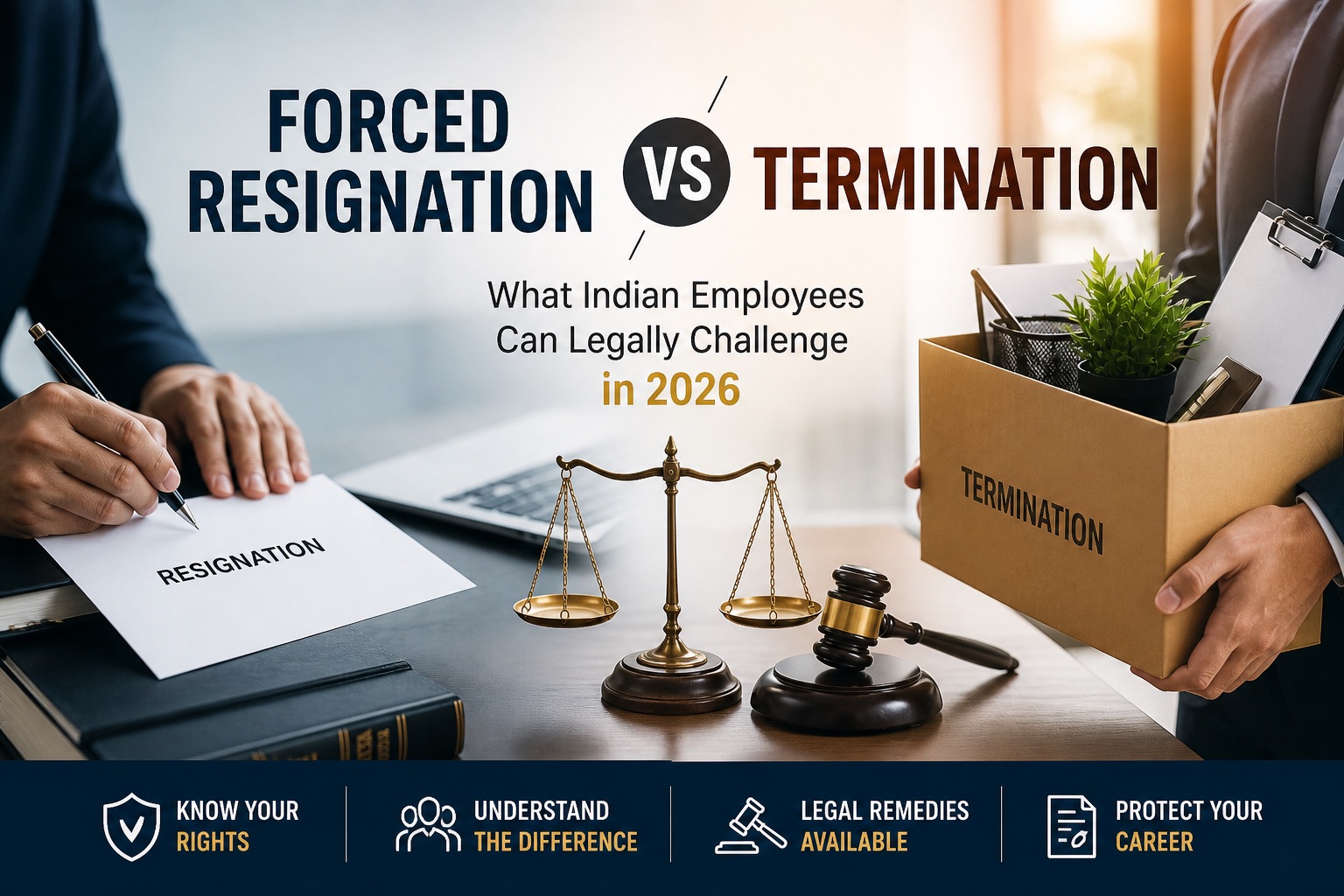
Forced Resignation vs Termination: What Indian Employees Can Legally Challenge in 2026
Introduction
Across India, a silent workplace trend is growing — employees are being pressured to resign instead of being formally terminated.
HR calls it “mutual separation.” Employees often experience it as coercion, threat, or emotional pressure.
Why does this happen? Because resignation protects employers from legal consequences, while termination triggers compliance obligations, disputes, and potential litigation.
So the key question is:
👉 Can a forced resignation be legally challenged?
👉 When does it become illegal under Indian law?
Let’s break it down.
1. Legal Framework Overview
This issue sits at the intersection of:
- Industrial Disputes Act, 1947 / Labour Codes (2020) – unfair labour practices
- Indian Contract Act, 1872 – consent must be free (no coercion, undue influence)
- Bharatiya Nyaya Sanhita, 2023 – criminal intimidation, coercion
- Constitution of India – fairness, dignity, livelihood rights
👉 A resignation must be voluntary. If not, it can be treated as illegal termination.
2. Key Provisions of the Bare Acts
Industrial Disputes Act, 1947 / Labour Codes
- Termination must follow due process (notice, reason, compensation)
- Unfair labour practices are prohibited
Indian Contract Act, 1872
- Section 13: Consent must be free
- Section 14: Consent is not free if obtained by coercion, undue influence, fraud, or misrepresentation
👉 Forced resignation = voidable agreement
Bharatiya Nyaya Sanhita, 2023
- Section 351: Criminal intimidation
- Section 352: Intentional insult provoking breach of peace
👉 Threatening job loss or career harm may cross into criminal territory.
3. What Is “Forced Resignation”?
A resignation is considered forced when:
- Employee is pressured with termination threats
- HR uses performance allegations without proof
- Employee is denied access to systems or work
- Employee is told: “Resign or we terminate you”
👉 Legally, this may amount to constructive dismissal.
4. Forced Resignation vs Termination (Key Difference)
| Aspect | Resignation | Termination |
| Nature | Voluntary | Employer-initiated |
| Legal scrutiny | Minimal | High |
| Compensation | Usually none | Notice + severance |
| Challenge possible | If forced | Always challengeable |
👉 Employers prefer resignation to avoid liability.
5. Judicial Precedents & Case Laws
- Balram Gupta v. Union of India
→ Resignation can be withdrawn if not voluntary - Punjab National Bank v. P.K. Mittal
→ Forced resignation treated as termination - Nand Keshwar Prasad v. Indian Farmers Fertiliser Cooperative
→ Coercion invalidates resignation
👉 Courts consistently hold:
“If resignation is not voluntary, it is illegal.”
6. When Can You Legally Challenge It?
You can challenge if:
- You were threatened or coerced
- You resigned under mental pressure
- You were denied fair hearing
- You were forced to sign documents immediately
👉 Burden shifts to employer to prove voluntary resignation.
7. Remedies Available to Employees
Legal Remedies:
- File complaint before Labour Commissioner
- Raise industrial dispute under Labour Codes
- File civil suit for damages
- File writ petition (for government/public sector jobs)
Possible Outcomes:
- Reinstatement
- Back wages
- Compensation
8. Employer Liability & Risks
Employers risk:
- Labour court orders for reinstatement
- Payment of back wages
- Penalties for unfair labour practices
- Reputational damage
👉 Increasingly, courts are scrutinizing HR practices.
9. Evidence & Documentation (Critical)
Employees must preserve:
- Emails/messages showing pressure
- HR call recordings (if legally obtained)
- Exit documents signed under pressure
- Witness statements
👉 Under Bharatiya Sakshya Adhiniyam, 2023, electronic evidence must be authenticated (Section 63 certificate).
10. Real-Life Case Scenarios
- IT Company (Bengaluru, 2024): Employee reinstated after proving resignation was forced
- Banking Sector Case: Mass resignations challenged as “coercive exits”
- Startup Layoffs (2023): Employees alleged silent termination disguised as resignation
👉 Trend: Courts increasingly side with employees when coercion is proven.
11. Practical Strategy Checklist
For Employees
✅ Never resign immediately under pressure
✅ Ask for written reasons
✅ Record conversations (where legally permissible)
✅ Seek legal advice before signing
For Employers
✅ Avoid coercive HR tactics
✅ Document performance issues properly
✅ Follow due process before termination
✅ Offer fair exit packages
12. Future Legal Outlook
- Labour Codes likely to strengthen employee protections
- Courts may formally recognize constructive dismissal doctrine
- Rise in employment litigation post-layoffs
- Stronger compliance expectations from HR departments
Conclusion
Forced resignation is not just unethical — it can be illegal.
If an employee resigns under pressure, Indian law allows them to challenge it as wrongful termination and seek compensation or reinstatement.
👉 The principle is clear:
Consent must be free — even in employment.
📞 Call-to-Action
At ProLegalMinds, we:
- Represent employees in wrongful termination disputes
- Advise corporates on compliant HR policies
- Handle labour litigation and settlement negotiations
🌐 Website: https://prolegalminds.com/
📅 Book Meeting: https://cal.com/prolegalminds
📱 WhatsApp: +919494051717
📞 Call: +919494051717
🔗 LinkedIn: https://www.linkedin.com/company/prolegalminds/
If your resignation wasn’t truly yours — the law is on your side.