
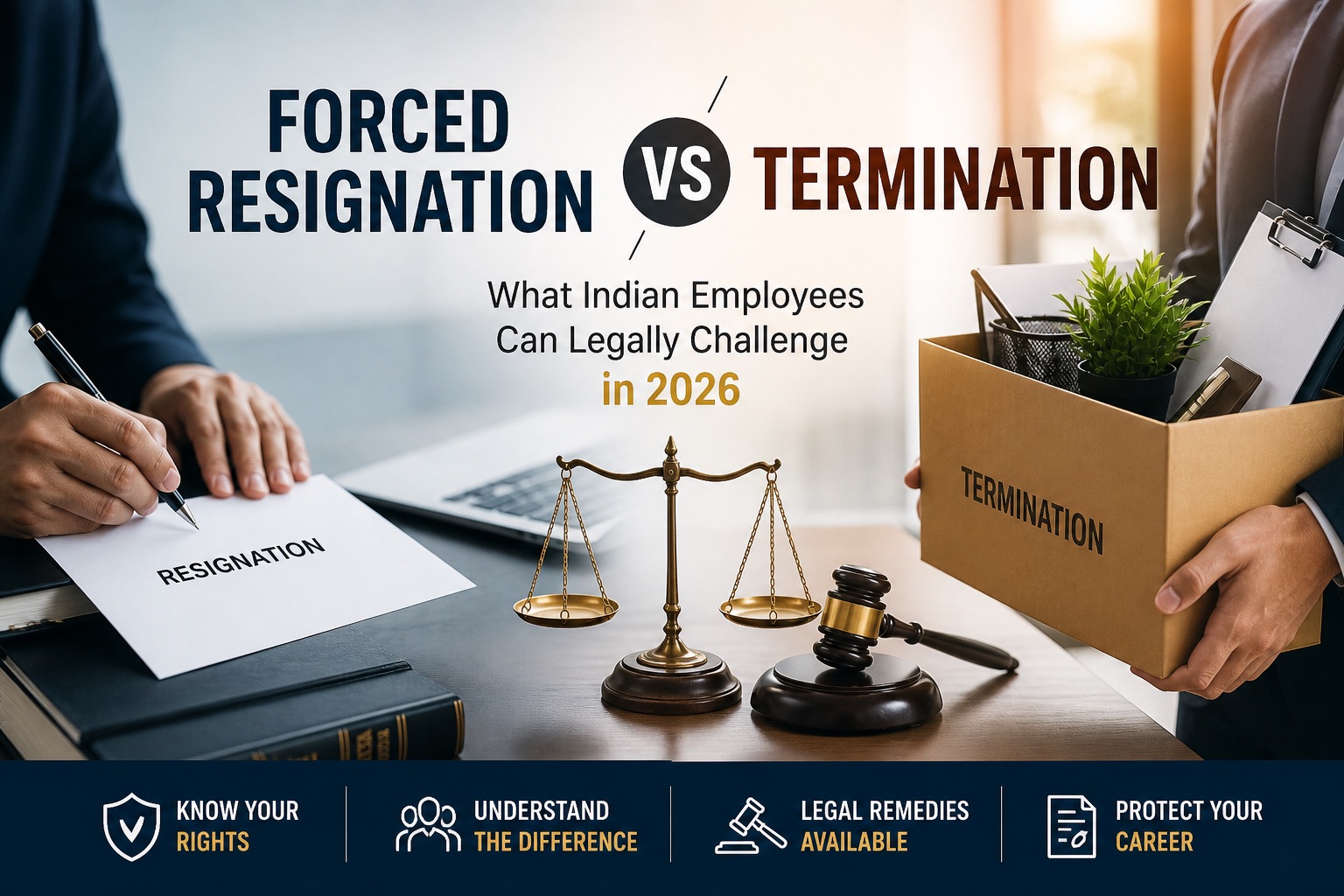
Introduction Across India, a silent workplace trend is growing — employees are being pressured to resign instead of being formally terminated. HR calls it “mutual separation.” Employees often experience it as coercion, threat, or emotional pressure. Why does this happen? Because resignation protects employers from legal consequences, while termination triggers compliance obligations, disputes, and potential litigation. So the key question is: 👉 Can a forced resignation be legally challenged?👉 When does it become illegal under Indian law? Let’s break it down. 1. Legal Framework Overview This issue sits at the intersection of: 👉 A resignation must be voluntary. If not, it can be treated as illegal termination. 2. Key Provisions of the Bare Acts Industrial Disputes Act, 1947 / Labour Codes Indian Contract Act, 1872 👉 Forced resignation = voidable agreement Bharatiya Nyaya Sanhita, 2023 👉 Threatening job loss or career harm may cross into criminal territory. 3. What Is “Forced Resignation”? A resignation is considered forced when: 👉 Legally, this may amount to constructive dismissal. 4. Forced Resignation vs Termination (Key Difference) Aspect Resignation Termination Nature Voluntary Employer-initiated Legal scrutiny Minimal High Compensation Usually none Notice + severance Challenge possible If forced Always challengeable 👉 Employers prefer resignation to avoid liability. 5. Judicial Precedents & Case Laws 👉 Courts consistently hold:“If resignation is not voluntary, it is illegal.” 6. When Can You Legally Challenge It? You can challenge if: 👉 Burden shifts to employer to prove voluntary resignation. 7. Remedies Available to Employees Legal Remedies: Possible Outcomes: 8. Employer Liability & Risks Employers risk: 👉 Increasingly, courts are scrutinizing HR practices. 9. Evidence & Documentation (Critical) Employees must preserve: 👉 Under Bharatiya Sakshya Adhiniyam, 2023, electronic evidence must be authenticated (Section 63 certificate). 10. Real-Life Case Scenarios 👉 Trend: Courts increasingly side with employees when coercion is proven. 11. Practical Strategy Checklist For Employees ✅ Never resign immediately under pressure✅ Ask for written reasons✅ Record conversations (where legally permissible)✅ Seek legal advice before signing For Employers ✅ Avoid coercive HR tactics✅ Document performance issues properly✅ Follow due process before termination✅ Offer fair exit packages 12. Future Legal Outlook Conclusion Forced resignation is not just unethical — it can be illegal. If an employee resigns under pressure, Indian law allows them to challenge it as wrongful termination and seek compensation or reinstatement. 👉 The principle is clear:Consent must be free — even in employment. 📞 Call-to-Action At ProLegalMinds, we: 🌐 Website: https://prolegalminds.com/📅 Book Meeting: https://cal.com/prolegalminds📱 WhatsApp: +919494051717📞 Call: +919494051717🔗 LinkedIn: https://www.linkedin.com/company/prolegalminds/ If your resignation wasn’t truly yours — the law is on your side.

Introduction Imagine receiving a call from your son, spouse, or boss — their voice sounds exactly real — asking for urgent money. You transfer funds… only to later discover it was an AI-generated voice clone. This is no longer hypothetical. Across India, AI voice cloning scams are rising rapidly, exploiting trust and technology. Victims lose money, but a deeper legal question arises: 👉 Can you be held legally liable for fraud committed using your cloned voice?👉 What protections does Indian law offer? Let’s break this down through the lens of criminal law, cyber law, and data protection in 2025. 1. Legal Framework Overview AI voice cloning scams intersect multiple laws: This creates a multi-layered liability framework involving both victim protection and criminal accountability. 2. Key Provisions of the Bare Acts Bharatiya Nyaya Sanhita, 2023 (BNS) 👉 AI voice scams clearly fall under cheating + impersonation. Information Technology Act, 2000 👉 Voice cloning = digital identity theft. DPDP Act, 2023 👉 Companies/platforms enabling misuse may face penalties. 3. How AI Voice Cloning Works (Legal Relevance) 👉 Legally, this creates false attribution of identity, crucial for criminal liability analysis. 4. Judicial Perspective & Case Law India has no direct AI voice cloning case yet, but courts rely on principles from: 👉 Courts are expanding existing laws to cover AI misuse. 5. Can YOU Be Held Liable? (Core Legal Question) ❌ Short Answer: NO — if you are the victim Liability requires: If your voice is cloned without consent: ⚠️ When Liability MAY Arise: 👉 Otherwise, law protects you. 6. Liability of Actual Fraudsters Fraudsters face: 👉 Multiple charges can apply simultaneously. 7. Liability of Platforms & Tech Companies Platforms may be liable if: But they get safe harbour protection (Section 79 IT Act) if: 8. Evidence & Investigation (Critical Section) Under Bharatiya Sakshya Adhiniyam, 2023: 👉 Courts may require expert testimony to prove deepfake/AI manipulation. 9. Remedies Available to Victims Immediate Actions: Legal Remedies: 10. Real-Life Case Scenarios 👉 Pattern: trust exploitation + urgency + emotional trigger 11. Practical Prevention Checklist For Individuals ✅ Avoid sharing voice samples publicly✅ Verify calls with secondary confirmation✅ Use code words within family For Corporates ✅ Implement multi-level authorization for payments✅ Train employees on AI scam awareness✅ Use AI-detection tools 12. Future Legal Outlook 👉 India is moving toward explicit AI regulation. Conclusion AI voice cloning scams are a serious threat — but Indian law is clear: 👉 Victims are not liable for fraud committed using their cloned voice.👉 The real culprits are punishable under BNS and IT Act provisions. However, as technology evolves, the law must evolve faster — and stronger AI-specific laws are inevitable. At ProLegalMinds, we: 🌐 Website: https://prolegalminds.com/📅 Book Meeting: https://cal.com/prolegalminds📱 WhatsApp: +919494051717📞 Call: +919494051717🔗 LinkedIn: https://www.linkedin.com/company/prolegalminds/ AI is powerful — but the law is your protection. Use it.
Introduction On May 2025, the Supreme Court of India took a significant step toward addressing inconsistencies in compensation awarded to victims of hit-and-run accidents across India. In a landmark directive, the Apex Court called for uniformity in the compensation framework under the Motor Vehicles Act, signaling a shift toward a more equitable and transparent legal standard. This article explores the legal framework, current issues, Supreme Court’s intervention, and the remedies available for victims and their families. 1. Legal Framework Governing Hit-and-Run Cases in India 1.1 Definition of Hit-and-Run As per Section 161(1) of the Motor Vehicles Act, 1988 (amended in 2019): “Hit and run motor accident” means an accident arising out of the use of a motor vehicle the identity whereof cannot be ascertained despite reasonable efforts for the purpose.” This definition clearly identifies cases where the offending vehicle flees the scene and cannot be traced. 1.2 Section 161: Compensation Scheme for Hit-and-Run Victims Bare Act Provision: Section 161(3): “Subject to the provisions of this Act, there shall be paid compensation of a sum of ₹2,00,000 in the case of death and ₹50,000 in the case of grievous hurt to the victim or the legal representatives of the victim of a hit and run motor accident.” Explanation: 2. Supreme Court’s Concern: Injustice Through Inconsistency In the recent matter [In Re: Uniform Compensation for Hit-and-Run Cases, 2025], the Supreme Court bench led by CJI D.Y. Chandrachud observed that: “There exists an unjustifiable disparity in compensation awarded across states and tribunals, leading to unequal treatment of victims based on geography rather than legal rights.” The Court called for: 3. Issues with the Current Compensation Model 3.1 Insufficient Compensation 3.2 Delays in Compensation 3.3 Lack of Awareness 4. Related Case Laws & Judicial Observations 4.1 Sarla Verma v. DTC (2009) 6 SCC 121 Though not a hit-and-run case, the Court laid down a structured formula for calculating just compensation under Section 166, which is often cited in accident-related matters. 4.2 K. Suresh v. New India Assurance Co. Ltd. (2012) 12 SCC 274 SC held that tribunals should ensure compensation is just and reasonable, suggesting that nominal amounts may fail the test of Article 21 protection. 4.3 SC Suo Moto Writ (2025) The Court noted that “Right to life includes the right to dignified compensation in case of wrongful loss of life.” 5. Remedies for Victims and Families 5.1 Claim Compensation under Section 161 5.2 File Under Section 166 (if Offender is Known) Victims may also seek additional or full compensation under: Section 166, MV Act: “Application for compensation in respect of accidents involving death or bodily injury.” This allows: 5.3 Filing a Writ for Delay or Denial 6. Proposed Reforms & Government Role 7. How ProLegalMinds Helps Victims At ProLegalMinds, we assist families with: Conclusion The Supreme Court’s proactive step in demanding uniformity in compensation for hit-and-run victims is a constitutional milestone that upholds Article 14 (Right to Equality) and Article 21 (Right to Life). For families suffering from such tragic incidents, understanding the legal remedies and structured support available under Indian law can make a huge difference in getting timely justice and financial relief. 🔍 Need Legal Help on Motor Accident Cases? 📞 Call: +91-9494051717 📱 WhatsApp: +91-9494051717 🌐 Visit: prolegalminds.com 📅 Book Meeting: Click to Schedule 🔗 LinkedIn: ProLegalMinds
Introduction India’s health sector is undergoing significant transformation. From the rise of digital healthcare platforms to enhanced public health regulations post-COVID, the legal landscape is shifting rapidly. The emerging legal challenges are no longer limited to traditional issues like medical negligence but have expanded into data privacy, telemedicine compliance, insurance disputes, and health infrastructure regulations. This blog unpacks the latest legal developments, bare act provisions, case laws, and strategic considerations for healthcare professionals, institutions, and legal advisors. 1. Legislative Framework Governing Health Laws in India India does not have a single unified health law. Instead, it operates under a web of laws at central and state levels. Key enactments include: 1.1. Clinical Establishments (Registration and Regulation) Act, 2010 Section 3 of the Act mandates all clinical establishments to be registered as per prescribed standards. Bare Act Extract:“No person shall run a clinical establishment unless it has been duly registered under this Act.” Explanation: This ensures minimum standardization and patient safety across clinics and hospitals. Many private establishments have faced penalties and temporary closures for non-compliance. Challenge: Several states have still not adopted the Act, creating a non-uniform regulatory environment. 1.2. Drugs and Cosmetics Act, 1940 The regulatory backbone for pharmaceuticals, this Act governs drug manufacture, distribution, and sale. Example: In 2023, a leading pharma company was fined ₹25 crore for selling substandard COVID medicines in Maharashtra. 1.3. Telemedicine Practice Guidelines, 2020 (Under Indian Medical Council Act) Post-pandemic, telemedicine has become a norm, but legal compliance remains an issue. Legal Risk: Tele-consultations without proper consent or prescribing controlled drugs online can lead to disciplinary actions under the National Medical Commission (NMC) Act, 2019. 1.4. Digital Personal Data Protection Act, 2023 For healthcare entities handling patient data, this Act is critically important. Section 4(2):“Personal data shall be processed only for lawful purposes for which the data principal has given consent.” Application to Health Sector: Penalties: As per Section 33, fines can go up to ₹250 crore for violations involving sensitive health data. 2. Public Health Policies and Challenges 2.1. National Health Policy, 2017 – Legal Impact While not a statute, this policy provides the vision for future health laws. Challenge: Implementation lags due to fiscal and administrative issues. 2.2. Mental Healthcare Act, 2017 Section 21(1):“Every person with mental illness shall have the right to access mental healthcare services run or funded by the government.” Legal Concern: Many patients are unaware of this statutory right, leading to litigation in High Courts for access to mental health beds or treatment reimbursement. 3. Legal Issues in Healthcare Delivery 3.1. Medical Negligence Guided by Jacob Mathew v. State of Punjab (2005) 6 SCC 1, the SC held that negligence requires “gross incompetence or recklessness.” With rising malpractice cases, legal advisors must prepare: 3.2. Insurance Disputes Hospitals face regular claim rejections from insurance companies, leading to litigation under the Consumer Protection Act, 2019. Case:In Max Hospital v. Policyholder (2023), NCDRC upheld compensation of ₹3 lakh for unjust denial of cashless insurance during emergency care. 4. Corporate Compliance in Health Sector Hospitals and pharma companies must comply with: 5. Future Trends and Legal Preparedness 6. Remedies for Non-compliance If a healthcare provider is charged under any of the above laws: Step 1: Immediate Legal Representation Retain legal counsel specialized in healthcare law or medical defense. Step 2: Regulatory Response Engage with authorities such as: Step 3: Appeal Mechanisms Step 4: Compliance Rectification Make necessary corrections (e.g., infrastructure upgrades, data audits) and submit compliance reports. Conclusion The Indian health sector is moving toward a more regulatory-heavy and compliance-driven framework. While this strengthens patient rights, it poses significant legal risks and challenges for providers. A proactive legal strategy, regular compliance audits, and awareness of emerging laws are crucial to navigating this evolving landscape. 📞 Need Legal Help in Health Sector Compliance or Litigation? ProLegalMinds provides expert legal counsel for hospitals, health-tech startups, pharma companies, doctors, and patients. 🌐 Website: https://prolegalminds.com/ 📅 Book a Meeting: https://meetings.hubspot.com/shiva20 📱 WhatsApp: +91 94940 51717📞 Call: +91 94940 51717🔗 LinkedIn: ProLegalMinds Would you like a matching LinkedIn post, image prompt, or emailer version of this blog?
🏛️ Introduction The Indian digital ecosystem is growing at an unprecedented pace. However, with increased content generation comes greater legal scrutiny, especially regarding obscenity, indecent representation, and child protection laws. Recently, the Supreme Court of India restrained a popular podcaster’s digital shows over alleged obscenity charges. This incident has once again brought attention to the stringent legal framework governing online content in India. In this blog, we explore: 1. Understanding “Obscenity” in Indian Law 1.1. Meaning of Obscenity The term ‘obscenity’ is not precisely defined but is understood in judicial interpretation. In Aveek Sarkar v. State of West Bengal (2014) 4 SCC 257, the Supreme Court clarified: “Obscenity must be judged from the point of view of an average person, applying contemporary community standards.” Thus, whether content is obscene depends on: 2. Applicable Laws on Digital Obscenity (Post-2024) 2.1. Bharatiya Nyaya Sanhita, 2023 (BNS) (Replacing IPC from 1st July 2024) Bare Act Provision: Section 292 BNS: “Sale, hire, distribution, public exhibition, circulation, import, export, or advertisement of obscene books, pamphlets, papers, drawings, paintings, representations, figures, or any other obscene object shall be punishable.” Explanation: “Obscenity” includes anything which: In-depth Explanation: Punishments: Offense Punishment First Conviction Up to 2 years imprisonment and/or fine. Subsequent Conviction Up to 5 years imprisonment and fine. Example: 2.2. Information Technology Act, 2000 (Amended 2024) Bare Act Provision: Section 67 IT Act: “Whoever publishes or transmits or causes to be published or transmitted in the electronic form, any material which is lascivious or appeals to the prurient interest, or if its effect is such as to tend to deprave and corrupt persons…” In-depth Explanation: Punishments: Offense Punishment First Conviction Up to 3 years imprisonment and fine up to ₹5 lakh. Subsequent Conviction Up to 5 years imprisonment and fine up to ₹10 lakh. Example: 2.3 The Indecent Representation of Women (Prohibition) Act, 1986 Bare Act Provision: Section 3: “No person shall publish, or cause to be published, or arrange or take part in the publication or exhibition or any advertisement which contains indecent representation of women in any form.” Section 4: “No person shall produce, sell, let to hire, distribute, circulate or send by post any book, pamphlet, paper, slide, film, writing, drawing, painting, photograph or representation containing indecent representation of women in any form.” Definition under Section 2(c): “Indecent representation of women” means the depiction in any manner of the figure of a woman, her form or body or any part thereof in such a way as to have the effect of being indecent, or derogatory to, or denigrating women, or is likely to deprave, corrupt or injure public morality.” In-depth Explanation: Penalties: Practical Application in Digital Era: Although the Act did not originally include digital media, by interpretative extension and through combined reading with the Information Technology Act, 2000, online publishers are now also held accountable. Example: Recent Developments: 2.4 The Protection of Children from Sexual Offences Act, 2012 (POCSO Act) Bare Act Provision: Section 11: “Whoever, intending to or knowing it to be likely that he will thereby cause sexual harassment to a child, — (a) utters any word or makes any sound, or makes any gesture or exhibits any object or part of body with the intention that such word, sound, gesture or object or part of body shall be heard or seen by the child; (b) makes a child exhibit his body or any part of his body so as it is seen by such person or any other person; © shows any object to a child in any form or media for pornographic purposes; or (d) repeatedly or constantly follows or contacts the child either directly or through electronic, digital or any other means;…” Section 13: “Whoever uses a child in any form of media (including program or advertisement, telecasting, distribution, display) for sexual gratification is said to commit the offence of using a child for pornographic purposes.” In-depth Explanation: Penalties: OffensePunishmentSexual harassment (Section 11)Up to three years imprisonment and fine.Use of child for pornography (Section 13)Rigorous imprisonment from five years to seven years, extendable for aggravated forms. Practical Application: Example: Landmark Cases: 3. Landmark Cases and Precedents 3.1. Aveek Sarkar v. State of West Bengal (2014) 3.2. Shreya Singhal v. Union of India (2015) 3.3. Recent 2024 SC Directive 4. Remedies If Someone is Charged If a person faces an obscenity charge, immediate legal steps include: 4.1. Engaging Legal Counsel 4.2. Filing for Anticipatory Bail 4.3. Challenging FIR/Proceedings 4.4. Compliance Corrections 5. How Content Creators Can Avoid Obscenity Charges 🔥 Conclusion With the evolving digital landscape, the boundaries of free expression and legal responsibility are tightening. Content creators, publishers, and even viewers must tread carefully, understanding the fine balance between creativity and compliance. Laws like BNS 2023, IT Act 2000, POCSO 2012, and Indecent Representation Act now actively regulate the Indian digital space. 💬 If you are facing or anticipating any legal issue regarding online content, consult expert legal advisors immediately to safeguard your rights and interests. ✍️ Authored By: ProLegalMinds — Legal Solutions for the Digital Era 🌐 Website: prolegalminds.com 📞 Call: +91 94940 51717 📱 WhatsApp: +91 94940 51717 🔗 LinkedIn: ProLegalMinds LinkedIn
In India, property leasing is primarily governed by two legal arrangements: Tenancy Agreement and Leave and License Agreement. These agreements cater to different needs, are regulated by distinct legal frameworks, and apply to various property types. This blog provides a detailed overview of both, including their legal provisions, possible use cases, property types, state-specific insights (with a focus on Hyderabad), and tailored recommendations for each property type. 1. Introduction to Tenancy Agreement and Leave & License Tenancy Agreement A Tenancy Agreement is a contract between a landlord (lessor) and a tenant (lessee) that transfers a possessory interest in a property to the tenant for a specified period in exchange for rent. The tenant enjoys exclusive possession and certain rights over the property. Leave and License Agreement A Leave and License Agreement allows the licensor (property owner) to grant the licensee (occupant) permission to use the property without transferring any proprietary interest. The licensee has no ownership or possessory rights. 2. Legal Provisions Governing Tenancy and Leave & License Agreements Tenancy Agreement Tenancy agreements are regulated by a combination of central and state laws, with significant variations across states. Key legal provisions include: Leave and License Agreement Leave and License agreements are designed to provide flexibility to property owners and avoid the rigid protections of tenancy laws. Key legal provisions include: 3. Key Differences Between Tenancy and Leave & License Agreements Aspect Tenancy Agreement Leave and License Agreement Nature of Right Transfers an interest in the property. Grants permission to use the property. Governing Law Rent Control Acts, Transfer of Property Act. Indian Easements Act, State-specific laws. Possession Tenant has exclusive possession. Licensee has no possession, only access. Duration Often long-term (>11 months). Typically short-term (≤11 months). Eviction Difficult; requires valid grounds and legal process. Easier; licensee must vacate upon expiry. Registration Mandatory for >11 months. Mandatory for >11 months; optional in some states. Transferability Tenant may sublet (if permitted). License is non-transferable. Legal Protection Strong tenant protections. Limited protections for licensee. 4. Possible Use Cases Tenancy Agreement Tenancy agreements are ideal for long-term, stable leasing arrangements. Common use cases include: Leave and License Agreement Leave and License agreements suit short-term, flexible arrangements. Common use cases include: 5. Different Property Types and Recommendations Both agreements apply to various property types, with specific considerations and recommendations for each: 6. Advantages and Disadvantages Tenancy Agreement Advantages: Disadvantages: Leave and License Agreement Advantages: Disadvantages: 7. Practical Considerations for Drafting Agreements Key Clauses in Tenancy Agreement Key Clauses in Leave and License Agreement Tips for Both Agreements 8. State-Specific Variations with Hyderabad Focus 9. Conclusion Tenancy Agreements and Leave and License Agreements are essential tools for property leasing in India, each serving distinct purposes. Tenancy agreements provide stability and tenant protections, making them suitable for long-term residential or commercial leases. Leave and License agreements offer flexibility and ease of eviction, ideal for short-term or temporary arrangements. In Hyderabad, the choice between the two depends on the property type, duration, and legal priorities. Residential properties in tech hubs like HITEC City favor Leave and License for flexibility, while commercial properties in established areas like Banjara Hills often use tenancy for stability. Always draft clear, legally compliant agreements, register where required, and consult local experts to navigate Telangana’s regulations. By understanding these agreements, landlords and occupants can ensure smooth, mutually beneficial leasing experiences.
Introduction The Indian digital ecosystem is growing at an unprecedented pace. However, with increased content generation comes greater legal scrutiny, especially regarding obscenity, indecent representation, and child protection laws. Recently, the Supreme Court of India restrained a popular podcaster’s digital shows over alleged obscenity charges. This incident has once again brought attention to the stringent legal framework governing online content in India. In this blog, we explore: 1. Understanding “Obscenity” in Indian Law 1.1. Meaning of Obscenity The term ‘obscenity’ is not precisely defined but is understood in judicial interpretation. In Aveek Sarkar v. State of West Bengal (2014) 4 SCC 257, the Supreme Court clarified: “Obscenity must be judged from the point of view of an average person, applying contemporary community standards.” Thus, whether content is obscene depends on: 2. Applicable Laws on Digital Obscenity (Post-2024) 2.1. Bharatiya Nyaya Sanhita, 2023 (BNS) (Replacing IPC from 1st July 2024) Bare Act Provision: Section 292 BNS: “Sale, hire, distribution, public exhibition, circulation, import, export, or advertisement of obscene books, pamphlets, papers, drawings, paintings, representations, figures, or any other obscene object shall be punishable.” Explanation: “Obscenity” includes anything which: In-depth Explanation: Punishments: Offense Punishment First Conviction Up to 2 years imprisonment and/or fine. Subsequent Conviction Up to 5 years imprisonment and fine. Example: 2.2. Information Technology Act, 2000 (Amended 2024) Bare Act Provision: Section 67 IT Act: “Whoever publishes or transmits or causes to be published or transmitted in the electronic form, any material which is lascivious or appeals to the prurient interest, or if its effect is such as to tend to deprave and corrupt persons…” In-depth Explanation: Punishments: Offense Punishment First Conviction Up to 3 years imprisonment and fine up to ₹5 lakh. Subsequent Conviction Up to 5 years imprisonment and fine up to ₹10 lakh. Example: 2.3 The Indecent Representation of Women (Prohibition) Act, 1986 Bare Act Provision: Section 3: “No person shall publish, or cause to be published, or arrange or take part in the publication or exhibition or any advertisement which contains indecent representation of women in any form.” Section 4: “No person shall produce, sell, let to hire, distribute, circulate or send by post any book, pamphlet, paper, slide, film, writing, drawing, painting, photograph or representation containing indecent representation of women in any form.” Definition under Section 2(c): “Indecent representation of women” means the depiction in any manner of the figure of a woman, her form or body or any part thereof in such a way as to have the effect of being indecent, or derogatory to, or denigrating women, or is likely to deprave, corrupt or injure public morality.” In-depth Explanation: Penalties: Practical Application in Digital Era: Although the Act did not originally include digital media, by interpretative extension and through combined reading with the Information Technology Act, 2000, online publishers are now also held accountable. Example: Recent Developments: 2.4 The Protection of Children from Sexual Offences Act, 2012 (POCSO Act) Bare Act Provision: Section 11: “Whoever, intending to or knowing it to be likely that he will thereby cause sexual harassment to a child, — (a) utters any word or makes any sound, or makes any gesture or exhibits any object or part of body with the intention that such word, sound, gesture or object or part of body shall be heard or seen by the child; (b) makes a child exhibit his body or any part of his body so as it is seen by such person or any other person; © shows any object to a child in any form or media for pornographic purposes; or (d) repeatedly or constantly follows or contacts the child either directly or through electronic, digital or any other means;…” Section 13: “Whoever uses a child in any form of media (including program or advertisement, telecasting, distribution, display) for sexual gratification is said to commit the offence of using a child for pornographic purposes.” In-depth Explanation: Penalties: OffensePunishmentSexual harassment (Section 11)Up to three years imprisonment and fine.Use of child for pornography (Section 13)Rigorous imprisonment from five years to seven years, extendable for aggravated forms. Practical Application: Example: Landmark Cases: 3. Landmark Cases and Precedents 3.1. Aveek Sarkar v. State of West Bengal (2014) 3.2. Shreya Singhal v. Union of India (2015) 3.3. Recent 2024 SC Directive 4. Remedies If Someone is Charged If a person faces an obscenity charge, immediate legal steps include: 4.1. Engaging Legal Counsel 4.2. Filing for Anticipatory Bail 4.3. Challenging FIR/Proceedings 4.4. Compliance Corrections 5. How Content Creators Can Avoid Obscenity Charges 🔥 Conclusion With the evolving digital landscape, the boundaries of free expression and legal responsibility are tightening. Content creators, publishers, and even viewers must tread carefully, understanding the fine balance between creativity and compliance. Laws like BNS 2023, IT Act 2000, POCSO 2012, and Indecent Representation Act now actively regulate the Indian digital space. 💬 If you are facing or anticipating any legal issue regarding online content, consult expert legal advisors immediately to safeguard your rights and interests. ✍️ Authored By: ProLegalMinds — Legal Solutions for the Digital Era 🌐 Website: prolegalminds.com 📞 Call: +91 94940 51717 📱 WhatsApp: +91 94940 51717 🔗 LinkedIn: ProLegalMinds LinkedIn
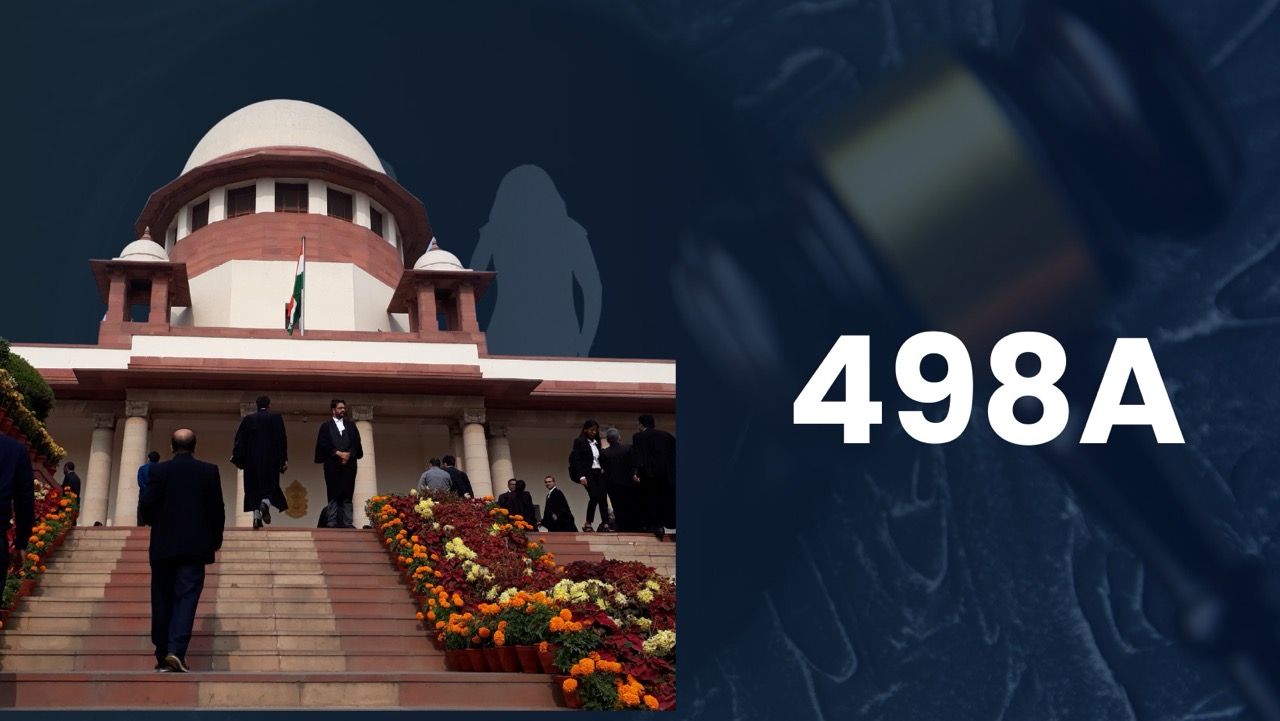
In a recent case titled “ACHIN GUPTA versus STATE OF HARYANA & ANR.”, the Supreme Court has raised significant concerns regarding the misuse of Section 498A of the Indian Penal Code (IPC) by wives against their husbands and in-laws. The Court, in its Criminal Appeal No. 2379 of 2024 arising out of SLP (Crl.) No. 4912 of 2022, urged the Parliament to introduce necessary amendments to the Bharatiya Nyaya Sanhita, 2023 (“BNS”), which includes provisions similar to Section 498A of IPC, such as Sections 85 and 86. The bench, comprising Justices JB Pardiwala and Manoj Misra, emphasized the need for legislative action, stating, “We request the Legislature to look into the issue as highlighted above taking into consideration the pragmatic realities and consider making necessary changes in Sections 85 and 86 respectively of the Bharatiya Nyaya Sanhita, 2023, before both the new provisions come into force.” Highlighting the similarity between the new provisions in BNS and Section 498A of IPC, the Court noted that while the text is nearly identical, the explanation to Section 498A of IPC is now a separate provision, i.e., Section 86 of the Bhartiya Nyaya Sanhita, 2023. This concern over the misuse of Section 498A is not new. In the case of Preeti Gupta v. State of Jharkhand (2010), the Court had previously expressed concerns about exaggerated complaints under Section 498A and urged legislative action to address these issues in light of practical realities and public opinion. Echoing the sentiments of the Preeti Gupta case, the judgment authored by Justice JB Pardiwala directed the Supreme Court registry to provide copies of the judgment to the Union Home Minister and Union Minister of Law & Justice for their attention. Background of the Case: The case originated from a divorce petition filed by the husband citing cruelty. In response, the wife filed an FIR against the husband under various sections of the IPC, including 498A. The High Court declined to quash the criminal case against the husband, citing the criteria outlined in the State of Haryana v. Bhajan Lal judgment, which allows quashing only in cases of manifestly malicious proceedings. Challenging the High Court’s decision, the husband appealed to the Supreme Court. Judgment: The Supreme Court observed that if criminal proceedings are initiated with the intention to harass the accused, the High Court should use its inherent powers under Section 482 of the Cr.P.C. to quash such proceedings. In this case, the Court concluded that continuing the criminal proceedings would amount to abuse of process and injustice. Therefore, the Court quashed the case against the accused/appellant. Furthermore, the Court directed that Section 498A IPC should not be applied mechanically in all complaints filed by wives. It emphasized that not all marital disputes amount to cruelty under the law. Conclusion: The Supreme Court’s stance underscores the need for balanced application of laws to prevent their misuse. The Court’s directives highlight the importance of considering practical realities and public opinion in legislative and judicial processes.
In the labyrinth of financial matters, the SARFAESI Act (Securitisation and Reconstruction of Financial Assets and Enforcement of Security Interest Act) is a potent tool for banks and financial institutions. However, when the Supreme Court grants leave for an SLP (Special Leave Petition) related to SARFAESI, it initiates a unique legal journey. This blog demystifies the process, explores relevant petition types and sections, outlines the rights of petitioners, and prescribes strategies for expediting resolution. Understanding SARFAESI and SLPs: 1. SARFAESI Act (2002): – Empowers banks to enforce security interests without court intervention. – Allows for the sale of secured assets to recover outstanding debts. 2. Special Leave Petition (SLP): – A remedy to appeal to the Supreme Court against any order or judgment. – Governed by Article 136 of the Constitution. When SLP is Granted: Transition to Civil Appeal: 1. Transition Process: – SLP granted, it transforms into a Civil Appeal. – Registry assigns a Civil Appeal number. 2. Filing of Documents: – Submit memorandum of appeal and documents. – Follow the Rules of the Supreme Court for filing. 3. Service on Respondent: – Serve notice to the opposite party/respondent. – Acknowledgment of service filed with the Court. Types of Petitions, Sections, and Rights: 1. Writ Petition under Article 32: – Challenge constitutional validity of SARFAESI provisions. – Invoke Article 32 for violation of fundamental rights. 2. Civil Appeal (Section 18 SARFAESI): – Section 18: – Deals with the right to appeal. – Rights: – Right to be heard before the appeal is disposed of. Strategies for Expedited Resolution: 1. Arguing Constitutional Validity: – Strategy: – Challenge SARFAESI provisions on constitutional grounds. – Argue for a speedy hearing due to fundamental rights implications. 2. Emphasizing Financial Implications: – Strategy: – Highlight financial losses during the pendency. – Demonstrate urgency for a quick resolution. 3. Seeking Interim Relief: – Strategy: – File interim applications for stay or specific reliefs. – Present strong grounds for immediate relief. 4. Utilizing Alternative Dispute Resolution (ADR): – Strategy: – Explore mediation or arbitration. – Propose ADR methods for a swifter resolution. 5. Engaging Expert Legal Counsel: – Strategy: – Appoint experienced lawyers well-versed in SARFAESI matters. – Ensure the legal team is equipped to handle expedited proceedings. 6. Technology Adoption: – Strategy: – Embrace e-filing and virtual hearings. – Advocate for tech-driven processes for efficiency. Conclusion: Navigating SARFAESI-related SLPs in the Supreme Court demands a strategic confluence of constitutional challenges, financial intricacies, and legal prowess. By understanding the transition to a Civil Appeal, leveraging the right types of petitions, and adopting a strategic approach, petitioners can expedite the resolution of SARFAESI matters. This blog serves as a compass for those traversing the SARFAESI legal landscape. SARFAESI LegalStrategy . Legal questions? Reach out to our experts at ProLegalMinds for guidance. Click the link to schedule your appointment now: https://meetings.hubspot.com/shiva20 or call us at +91–7799518123

As the gavel falls on judgment day in a criminal trial, the accused find themselves at a pivotal moment. A nuanced understanding of the legal remedies available becomes paramount in navigating the complexities of India’s criminal justice system. – Plea Bargaining (Section 265-A, CrPC): Section 265-A allows accused individuals to opt for plea bargaining, admitting guilt in exchange for a lighter sentence. – Probation of Offenders Act (Section 4): First-time offenders can seek release on probation under the Probation of Offenders Act, Section 4. – Writ Petitions (Article 226, 32, Constitution of India): Accused can approach the High Court (Article 226) or Supreme Court (Article 32) through writ petitions like habeas corpus, mandamus, or certiorari if there is a violation of fundamental rights. – Application for Suspension of Sentence (Section 389, CrPC): Section 389 allows the accused to seek the suspension of the sentence pending appeal, enabling them to remain out of custody during the appeal process. – Fresh Trial: In extraordinary circumstances, a fresh trial may be sought based on grounds like the discovery of new evidence. Client-Centric Approach: Conclusion: Judgment day need not be the final chapter for the accused. Armed with a comprehensive understanding of legal provisions, avenues like bail, appeals, and constitutional remedies offer a lifeline. Navigating this legal terrain demands strategic thinking and legal acumen. As the wheels of justice turn, the accused can find solace in the fact that the journey doesn’t end with the pronouncement of judgment. #CriminalJustice #LegalRemedies #IndianLaw